Sconces beside the TV or a light strip behind it? How to size and space sconces by screen size, mount a symmetrical pair, go cable-free with battery power and choose a light colour.
Contents
- Side sconces or a backlight behind the TV?
- How do you balance screen brightness and room light?
- How do you size and space sconces for your TV?
- How do you mount a symmetrical pair?
- Do battery-powered sconces solve the visible cable problem?
- How do sconces work on slat walls, panels and marble-effect walls?
- Which light colour suits a TV wall?
- Which option suits you? A decision table
- Frequently Asked Questions
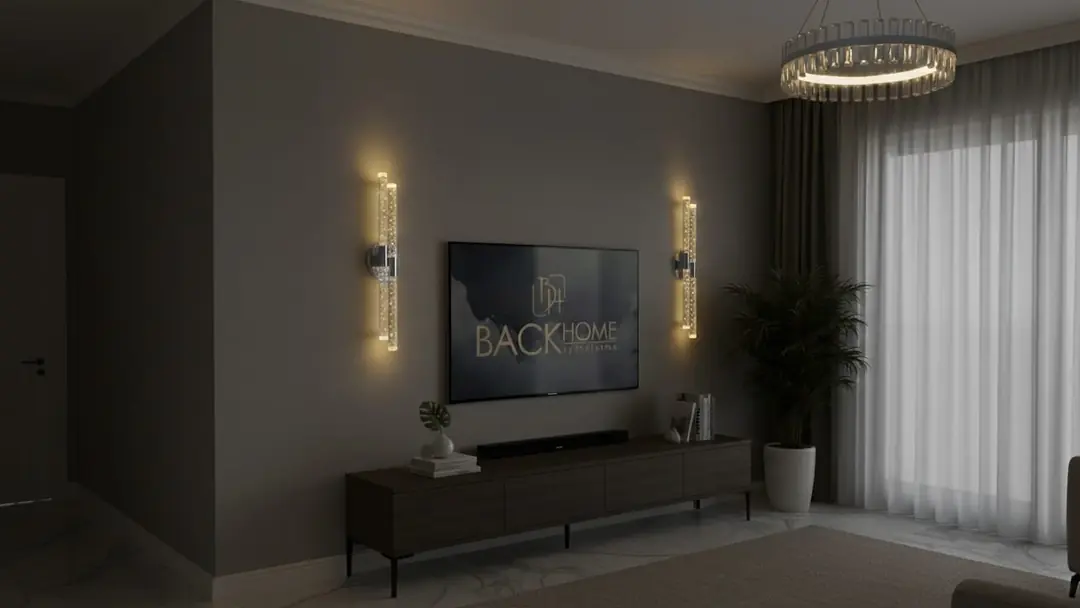
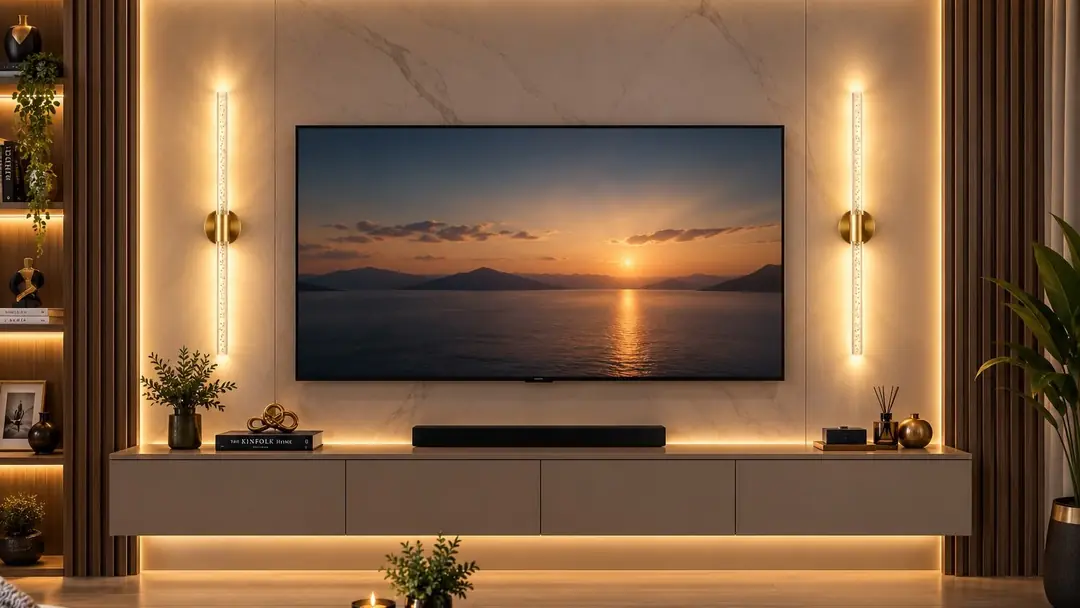
TV wall and TV unit lighting comes down to two options: a pair of vertical sconces either side of the screen, or an indirect light behind it that washes the wall. Sconces turn the wall into a decorative frame; light behind the screen creates a soft halo. In most living rooms, a 55–65 inch TV looks balanced with two 63–73 cm sconces mounted 15–30 cm (6–12 in) from the screen edges. Check your wall wiring first, then the screen size.
In short: Sconces beside the screen frame the whole TV wall, while light behind it softens the area around the screen; the two work well together. Choose sconces close to the screen height and mount them level, 15–30 cm from each edge. With no supply near the TV, a battery-powered model keeps the wall cable-free.
Side sconces or a backlight behind the TV?
Choose side sconces if you want the wall itself to stand out, and a backlight if you only want to soften the area around the screen. A side sconce is a decorative wall light mounted beside the screen that spreads light across the wall. A backlight is usually an LED strip stuck to the back of the TV; you see only the glow it reflects off the wall.
- Look: Sconces remain a design feature when the TV is off; a backlight disappears.
- Installation: Sconces are screwed to the wall; a strip sticks to the TV and often runs from its USB port.
The most balanced result comes from using both. This is layered lighting: general, ambient and accent light come from separate sources that you switch on as needed.
How do you balance screen brightness and room light?
The wall around the screen should not sit in total darkness, but the light around it should never be brighter than the screen. When the TV is the only light in a dark room, the contrast is high, and many people find a soft glow around a bright screen more comfortable.
- Make sure no light shines straight into your eyes from the sofa.
- Reflections mostly come from windows and lamps opposite the screen; sconces on the TV wall rarely cause them.
- For a film night, switch off the ceiling light and leave the sconces on.
- To dim the light, look at remote-controlled dimmable sconces.
For seated viewing, the screen centre usually sits 100–120 cm above the floor. Align the sconces to that line.
How do you size and space sconces for your TV?
As a general rule, pick sconces close to the height of the screen and mount them 15–30 cm from its side edges. Screen size is measured on the diagonal; on a 16:9 TV the height is roughly half of it. The table gives approximate figures, excluding the bezel.
| Screen size | Approx. screen height | Sconce length | Gap from screen edge |
|---|---|---|---|
| 43 in | 54 cm | 40–51 cm | 10–20 cm |
| 50 in | 62 cm | 51–63 cm | 15–25 cm |
| 55 in | 68 cm | 56–73 cm | 15–25 cm |
| 65 in | 81 cm | 63–73 cm | 20–30 cm |
| 75 in and above | 93 cm and above | 73 cm plus a backlight | 20–35 cm |
- Alignment: Line up the centre of each sconce with the centre of the screen.
- Unit clearance: Leave at least 10–15 cm between the sconce and the top of the TV unit, so decor does not block the light.
- Large screens: From 75 inches up, a 73 cm sconce is shorter than the screen, so add a backlight.
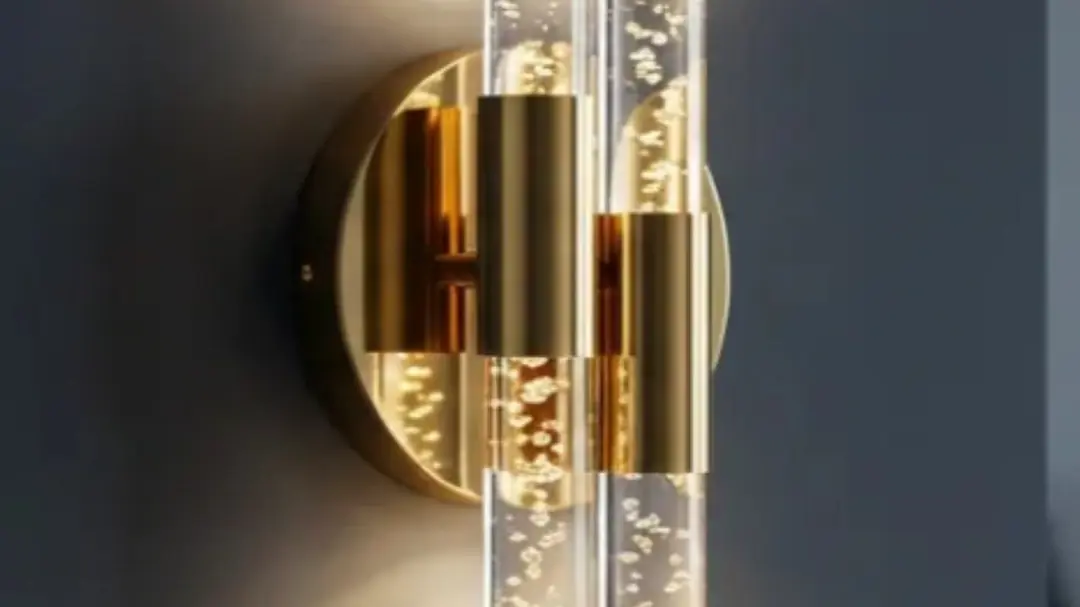
Designed for TV walls, Nova acrylic rod sconces are 73 cm long and 8 cm wide and come as a pair. The rod is 15 mm thick on the Nova 815 and 30 mm on the Nova 830: the slimmer rod draws a fine line, the thicker one a bolder stroke.
How do you mount a symmetrical pair?
In a symmetrical layout, both sconces sit at the same height and the same distance from the vertical centre line of the screen. The eye reads them as a frame, so a few centimetres of difference stands out. Measure from the screen centre, not the room corner.
- Mark the vertical centre line of the screen on the wall in pencil.
- Measure the same distance to each side: half the screen width plus your chosen gap.
- Use a spirit level to mark both sconce centres at the same height.
- Mark the screw points; a Nova pack includes 4 screws and 4 wall plugs for the pair.
- Before drilling, check for hidden cables and water pipes with a detector.
For the paper template method, see our guide to wall sconce height and placement.
Do battery-powered sconces solve the visible cable problem?
Yes. If there is no electrical supply near the TV, or you would rather not open up the wall, a battery-powered sconce gives a cable-free look. It runs on a battery inside its body and has an on/off switch. BACKHOME's battery-powered LED sconces take a 9V battery, and one comes with each sconce. Battery life depends on daily use and the battery brand.
A hardwired sconce connects to the electrical supply in your wall and runs on 110–220 V household power, with no bulb or adapter needed. Have a qualified electrician make the connection, with the circuit breaker switched off.
- Go battery-powered if there is no supply, you rent, or you use the lights occasionally.
- Go hardwired if there is a supply and the lights stay on for hours every evening.
Our battery vs hardwired comparison covers both in detail; if the wiring is ready, see the hardwired sconce range.
How do sconces work on slat walls, panels and marble-effect walls?
All three surfaces suit sconces; what changes is how the light looks and where the screw holds. Depending on the series, body colours include black, anthracite, silver and gold.
Wooden slat walls
Vertical slats run in the same direction as a vertical sconce. Centre the sconce over one slat or over the gap between two. The screw must hold in the batten or the wall behind. Gold and silver stand out on dark wood; black and anthracite contrast with light oak.
Lacquered or painted panels
Light spreads evenly on a flat panel and looks stronger on a dark one. With a cavity behind the panel, use cavity fixings or reach the solid wall.
Marble-effect walls
Glossy marble-effect surfaces reflect light and add a second shimmer around the sconce. Gold suits warm veining, silver suits grey and white patterns. Drill porcelain or ceramic with a tile bit and hammer mode off, or leave it to a professional fitter.
Which light colour suits a TV wall?
For evening viewing, most people prefer warm light, while white light looks crisper and more modern. Light colour is expressed in kelvin (K): as a general guide, 2700–3000 K is warm white, 3500–4500 K neutral and 5000 K and above cool white. On BACKHOME sconces you pick the colour by name rather than by kelvin value: warm or white.
- Warm: pairs with wood, earthy tones and gold bodies.
- White: draws a clean line on grey, concrete-effect and marble-effect walls.
- Remote-controlled RGB: switches between white, red, blue, green and yellow and dims from the remote.
Keep the sconces in step with the other lights in the room. Read more in our guide to warm and white light.
Which option suits you? A decision table
Choose a hardwired pair if there is a supply in the wall and a battery-powered pair if not, then set the length by screen size. The table matches common situations with a suggestion.
| Situation | Suggestion | Note |
|---|---|---|
| Supply in the wall, lights on for hours | Hardwired pair | Electrician connects, breaker off |
| No supply, wall stays closed | Battery-powered pair | 9V battery, on/off switch |
| 43–50 inch screen | 40–63 cm sconces | 10–25 cm from the edge |
| 55–65 inch screen | 63–73 cm, such as Nova | 15–30 cm from the edge |
| 75 inch or larger | 73 cm plus a backlight | Centred on the screen |
| Unsure how it will look | Try it on a photo | Confirm with a tape measure |
For the last row, use the See it in your room tool: upload a wall photo, place the sconce on it and view it lit or unlit. It is a visual preview; confirm the position with a tape measure.
Frequently Asked Questions
How far from the TV should wall sconces be?
As a general rule, mount sconces 15–30 cm (6–12 in) from the side edges of the screen: 10–20 cm suits smaller screens such as 43 inches, and 20–35 cm suits 65 inches and above. Measure from the TV frame, keep both sides identical and leave 30 cm to the corner.
Will sconces next to the TV reflect on the screen?
Usually not. Sconces on the same wall as the TV throw their light onto the wall, not the screen glass; reflections mostly come from windows and lamps opposite. If your screen is very glossy, test the spot one evening with a torch held where the sconce will go.
How long does a battery-powered TV sconce last?
There is no fixed figure: battery life depends on daily use and the battery brand. BACKHOME battery-powered sconces take a 9V battery, and one comes with each sconce. If the lights will be on for hours every evening, a hardwired model is more practical.
How is a hardwired TV sconce connected?
A hardwired sconce connects to the electrical supply in your wall. Have a qualified electrician make the connection with the circuit breaker switched off. If there is no supply beside the TV, an electrician can add one; plan it before painting or panelling.
What length of sconce suits a 55 inch TV?
A 55 inch screen is about 68 cm (27 in) tall without the bezel, so sconces of 56–73 cm look proportionate. A 73 cm sconce extends slightly above and below the screen and frames it neatly. Align its centre with the centre of the screen.
Can you mount a sconce on a wooden slat TV wall?
Yes, as long as the screw holds in the batten or the wall behind, not just the slat. Centre the sconce over one slat or the gap between two, and check for cables and pipes with a detector first. For hardwired models, plan the outlet point before the slats go up.
Pick the sconce length from your screen size, align the pair on the centre of the screen and choose battery or hardwired based on your wall. To see the options, browse our TV unit sconces and try your favourite on a photo of your own wall.