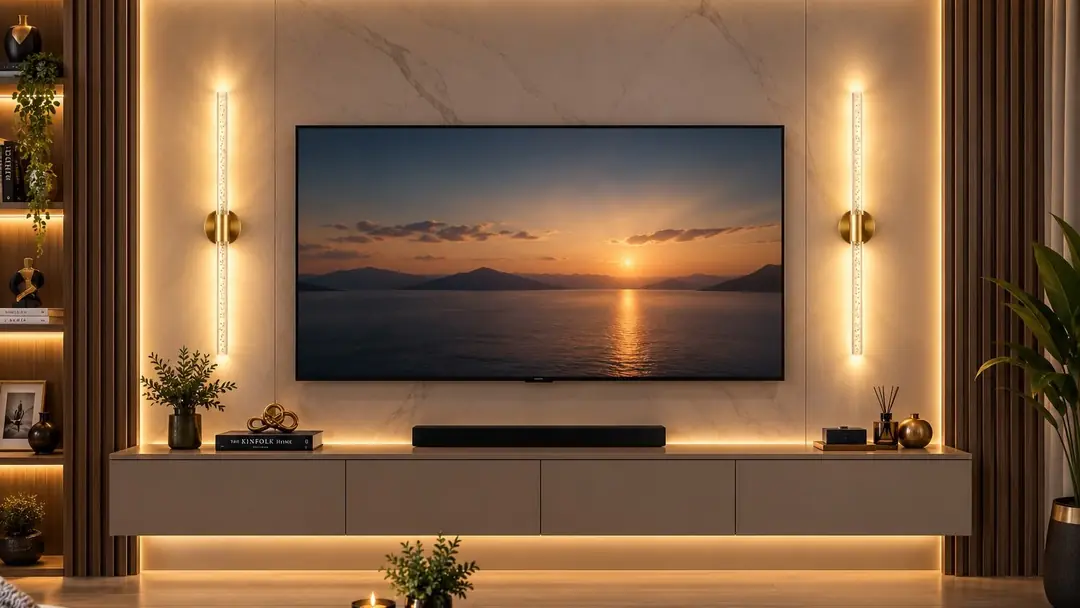

Why warm light suits living rooms and bedrooms while white light suits hallways and desks. Learn what Kelvin means, see a room-by-room table and know when an RGB sconce makes sense.
Contents
- What is colour temperature, and what does Kelvin tell you?
- What is the difference between warm light and white light?
- Which light colour suits the living room and bedroom?
- Which colour works in hallways, entrances and outside the bathroom?
- What light should you pick behind the TV and at a desk?
- Which light colour goes in which room?
- When does an RGB remote sconce make sense?
- Should you mix warm and white light in the same room?
- How can you preview the light colour at home?
- Frequently Asked Questions
Choosing between warm light or white light depends on what the room is for. Where you unwind, in the living room, the bedroom or behind the TV, a warm, yellowish tone usually creates a softer mood. In hallways, entrances, outside the bathroom and at a desk where you need focus, white light gives a crisper view. Light colour is measured in Kelvin. Below we explain the Kelvin ranges, then give a room-by-room table and a short guide to RGB remote sconces.
In short: Use warm light where you relax and white light where you work or pass through. Keep sconces that are on at the same time in one light colour. RGB remote models make sense in the living room and TV corner, where you may want the mood to change.
What is colour temperature, and what does Kelvin tell you?
Colour temperature is a measure of how yellow or how bluish-white a light source looks, expressed in Kelvin (K). The lower the number, the more the light shifts toward yellow and orange; the higher it goes, the whiter and bluer it gets. It can feel backwards, but warm light has the low number: the scale describes the colour of the light, not its heat.
- 2700–3000 K, warm white: a yellowish tone like an incandescent bulb.
- 3500–4500 K, neutral white: neither clearly yellow nor blue, close to indoor light at midday.
- 5000–6500 K, cool white: bluish and crisp, like office lighting.
These ranges are general information. BACKHOME sconces do not list a Kelvin number; you choose between two light colours, warm and white.
What is the difference between warm light and white light?
Warm light is a soft, yellowish tone; white light has no yellow cast and looks crisper and airier. On BACKHOME sconces, warm is the standard light colour and white is the optional one.
Watch out for a naming trap. Our warm option is labelled “warm light”, yet bulbs sold as “daylight” elsewhere are usually cool white in the 5000–6500 K band. Read the tone, not the name.
- Warm light softens wood, beige, cream and warm grey, and pairs with gold and anthracite bodies for a cosy look.
- White light looks clean on white, grey and cool-toned walls, and gives silver and black bodies a modern edge.
Which light colour suits the living room and bedroom?
In most homes warm light suits the living room and bedroom better, because these rooms are mostly used in the evening and for winding down.
Living room
Layered lighting means lighting a room with a mix of general, task and decorative light instead of a single ceiling fixture. With only the sconces on, warm light makes the room feel cozier. If your ceiling light is white and both will be on together, one colour looks more balanced.
Bedroom
Bedroom sconces usually sit on both sides of the bed or on the headboard wall. Many people find warm light more comfortable in the evening, so it is a common choice here. If you frame the bed with two Bubblelight sconces, order both in the same light colour.
Which colour works in hallways, entrances and outside the bathroom?
White light is usually more practical in hallways, entrances and outside the bathroom, but warm light works too if these spaces open onto a warm-lit room.
In passage areas, the aim is to see the way, the doors and the thresholds clearly. In a narrow, windowless hallway, white light makes the space feel more open, and many people find it clearer at an entrance mirror. If the hallway opens straight into a room with warm sconces, keeping it warm gives the home a continuous flow of colour.
By outside the bathroom we mean the wall beyond the door. Wet areas call for fixtures with a clearly stated moisture rating, so keep decorative sconces on the hallway side. Our guide to sconce mounting height explains how high to hang them.
What light should you pick behind the TV and at a desk?
Behind and beside the TV, warm or dimmable light makes more sense; at a desk, white light is the sensible choice.
Behind and beside the TV
In a dark room, a bright screen against a dark wall creates a sharp contrast. Soft light beside or behind the TV eases that contrast, and many people find it more comfortable on a film night. Warm light blends with the rest of the room, while remote-dimmable RGB models such as Bubbleflux RGB let you tune it. See our TV-side sconces for examples and our article on lighting around a TV unit for placement.
Desk or work corner
For reading, writing and screen work, many people find white light clearer. A decorative sconce does not replace a desk lamp, though; add a task light aimed at the work surface.
Which light colour goes in which room?
The short answer: warm light where you relax, white light where you work or pass through. The Kelvin column reflects general lighting practice, not measured values for BACKHOME products.
| Room | Suggested light colour | Typical Kelvin range | Watch out for |
|---|---|---|---|
| Living room | Warm | 2700–3000 K | Match a ceiling light on at the same time |
| Bedroom | Warm | 2700–3000 K | A separate reading light |
| Dining area | Warm | 2700–3000 K | Warm tones at the table |
| Behind or beside the TV | Warm or dimmable RGB | 2700–3000 K | Keep it dimmer than the screen |
| Hallway | White, or match the next room | 3000–4000 K | Match the room it opens onto |
| Entrance | White | 3500–4500 K | Clear view at the mirror |
| Outside the bathroom | White | 3500–4500 K | No decorative sconces in wet areas |
| Desk or work corner | White | 4000–5000 K | Pair with a desk lamp |
When does an RGB remote sconce make sense?
An RGB remote sconce makes sense when you want the same wall to set a different mood at different times. RGB is an LED setup that mixes red, green and blue light to produce different colours. BACKHOME’s RGB remote-controlled sconces offer white, red, blue, green and yellow, and you can dim them with the remote.
- You want different moods in the living room for films, guests and quiet evenings.
- You want to dim the TV corner from the sofa.
In bedrooms and hallways, most people prefer a fixed tone; if you love a steady warm glow, the warm-light model is simpler. Power options for remote models vary by series, so check battery or hardwired on the product page. Our battery or hardwired LED sconce guide explains the trade-offs.
Should you mix warm and white light in the same room?
No; in most homes, lights that are on at the same time look more balanced in one colour. When two tones glow side by side, part of the wall looks yellow and part looks bluish, and the eye tends to read that as untidy.
- Always order a pair of sconces on the same wall in the same light colour.
- If your ceiling light is white and will be on with the sconces, choose white; if the sconces are a separate evening light, warm works too.
- In an open-plan living and kitchen space, let the colour change fall on a natural border such as a wall, a column or a doorway.
The exception is an RGB remote model: you change its colour on purpose, so it is a choice, not a mismatch.
How can you preview the light colour at home?
To preview the light colour, try the sconce on a photo of your own room, then test with bulbs you already have. With our See it in your room tool, you upload a photo of your wall or room, drag the product image into place, resize and rotate it, and see the light on or off. The photo is processed only in your browser and is never sent to a server.
Screen colours can differ slightly from real light, so use the tool for placement and fit, and settle the colour with a quick test:
- In the evening, try a warm and a white bulb in turn in a lamp near the wall.
- See which tone flatters the wall, the furniture and the fabrics.
- Match the sconces to the other lights that will be on in the room.
Put simply: warm where you relax, white where you work or pass through, and one colour for lights that are on together. With these rules, choosing among our LED wall sconces gets easier. For a bubbly, multi-column look, explore the Aura series too.
Frequently Asked Questions
Does a warm light LED sconce glow yellow?
Yes, a warm light LED sconce glows in a warm, yellowish tone. Do not confuse it with bulbs sold as “daylight”, which are usually cool white. In general lighting terms this tone usually falls around 2700–3000 K, but on BACKHOME product pages you choose by name, warm or white, not by Kelvin.
Is warm light or white light better for a bedroom?
Warm light is the usual choice for a bedroom. Many people find warm light more comfortable in the evening, which is when bedrooms are mostly used. If you read in bed, add an adjustable reading lamp; decorative sconces set the mood but do not replace a reading light.
How does light colour change as the Kelvin value goes up?
As the Kelvin value rises, light shifts from yellow to white and then to bluish white. As a rule of thumb, 2700–3000 K counts as warm, 3500–4500 K as neutral and 5000–6500 K as cool white.
What light colour works for hallway sconces?
White light gives a clear view in a hallway, but if the hallway opens onto a warm-lit living room or bedroom, warm light blends in better. In narrow, windowless hallways, white makes the space feel more open. Let the adjoining room guide you.
What colours does an RGB remote-controlled LED sconce offer?
BACKHOME RGB remote-controlled LED sconces offer white, red, blue, green and yellow, and the remote also dims the light. They suit a living room or TV corner where the mood changes through the evening. For a steady warm tone, the warm-light model is simpler.
Can you use warm and white sconces in the same room?
We advise against it if they will be on at the same time, because different tones side by side make the wall look patchy. Order a pair of sconces on one wall in a single light colour, and match them to a ceiling light that stays on with them.