How high should a wall sconce go? Heights for hallways, living rooms, bedsides, stairs, entrance halls and TV walls, spacing between sconces, the paper template trick and testing with See it in your room.
Contents
- How high should a wall sconce be mounted?
- How does sconce height change from room to room?
- How far apart should two sconces be?
- How do you choose sconce length for your ceiling height?
- When does a layout need to be symmetrical?
- How do you mark the position before mounting?
- How do you try a sconce position with See it in your room?
- Frequently Asked Questions
The usual rule for wall sconce height is to mount the centre of the sconce 150–170 cm (59–67 in) above the floor, just above the eye level of a standing adult. Beside a bed this drops to 120–150 cm; next to a TV, the sconce lines up with the screen centre. In hallways, leave 200–300 cm between sconces. Match the length to your ceiling and test the spot before drilling, for example on a photo of your own wall with the See it in your room tool.
In short: Mount the centre of a wall sconce about 150–170 cm above the floor, 120–150 cm beside a bed, and level with the screen centre next to a TV. Space hallway sconces 200–300 cm apart. Test the spot on the wall and with See it in your room, then fix it with a tape measure.
How high should a wall sconce be mounted?
In most homes, the centre of a wall sconce sits 150–170 cm above the floor. That is just above the eye level of a standing adult, so the light spreads across the wall instead of shining into your eyes. Work with the centre height: the distance from the floor to the middle of the sconce body. It makes models of different lengths easy to compare.
- With a sofa, bedside table or console in front, measure relative to the furniture.
- With a ceiling above 280 cm, move towards the top of the range.
How does sconce height change from room to room?
Sconce height follows what you do in the room: just above eye level where you walk through, lower where you sit or lie down. On stairs, measure from the stair nosing, the front edge of each tread.
| Space | Centre height from the floor | Horizontal placement |
|---|---|---|
| Hallway | 150–170 cm | 200–300 cm apart |
| Living room, above a sofa or console | 150–170 cm | Symmetrical at both ends |
| Bedside | 120–150 cm | 10–25 cm outside the headboard |
| Staircase | 150–170 cm from the nosing | 200–300 cm apart, following the slope |
| Entrance hall, beside a mirror | 150–165 cm | 10–15 cm from the mirror edge |
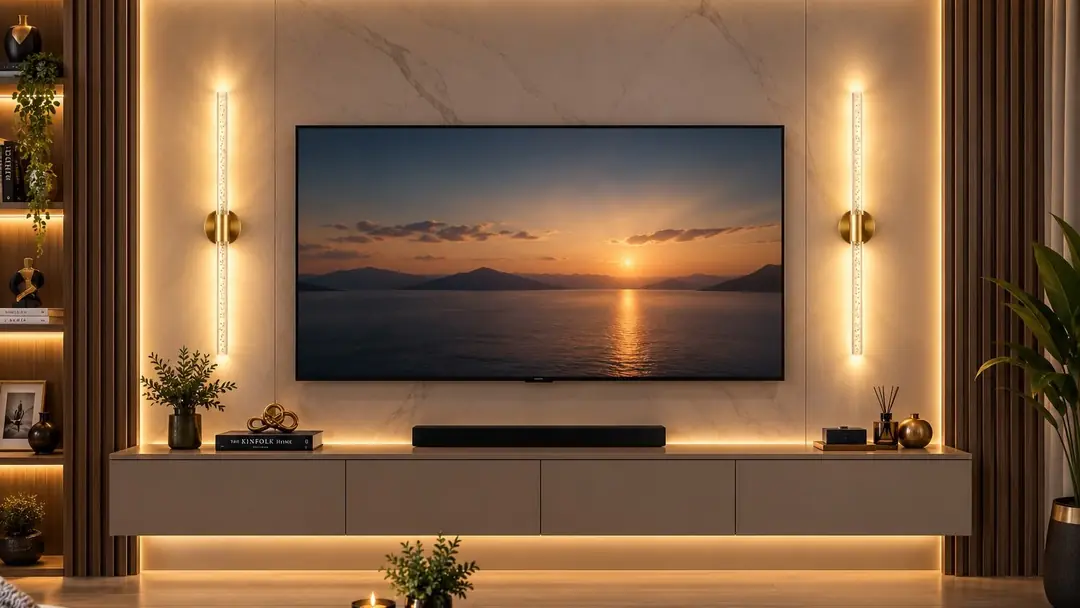
| Beside the TV | Screen centre, usually 100–120 cm | 15–30 cm from the screen edge |
Hallway
Keep hallway sconces slim. Models 4–5 cm deep keep a narrow passage clear: slim Bubblelight sconces and the Aura series are 5 cm deep, Bubbleflux 4 cm. Place the first and last sconce 60–100 cm in from each end.
Living room
Set sconces above a sofa or console 10–20 cm in from each end, with at least 30 cm between the bottom of the sconce and the sofa back.
Bedside
The sconce should sit just above shoulder height when you sit up in bed, about 60–80 cm above the mattress. Lengths of 31–40 cm look proportionate here. A decorative sconce may not be enough for reading, so add a reading lamp if you read in bed. For the tone, see our guide to choosing light colour.
Staircase
Measure each sconce at the same height from the nosing beneath it, so the row follows the slope. Tall stairwells suit 56–73 cm lengths. Keep the top and bottom of the stairs lit.
Entrance hall
Sconces either side of a mirror should be level with its centre, usually 150–165 cm up. Put a single sconce by the front door on the side away from the door swing.
Beside the TV
Next to a TV, align the sconce with the screen centre and mount it 15–30 cm from the edge. For sizes by screen, see our TV wall and TV unit lighting guide.
How far apart should two sconces be?
In hallways and on stairs, leave 200–300 cm between sconces; when a pair frames a focal point, the object between them sets the distance. The aim is to avoid dark gaps.
- Hallways and stairs: near 200 cm for short sconces and low ceilings, near 300 cm for long ones.
- Sofa or console: the furniture width minus 10–20 cm on each side; on a 200 cm sofa, about 160–180 cm.
- Bed: the bed width plus 10–25 cm on each side; on a 160 cm bed, about 180–210 cm.
- Corners: at least 30 cm between any sconce and the wall corner.
How do you choose sconce length for your ceiling height?
The lower the ceiling, the shorter the sconce: standard 250–260 cm ceilings suit 31–51 cm, and ceilings of 290 cm and above suit 51–73 cm. As a practical check, leave at least 40 cm between the top of the sconce and the ceiling.
| Ceiling height | Sconce length | Centre height |
|---|---|---|
| 240–260 cm | 31–51 cm | 150–160 cm |
| 260–290 cm | 40–63 cm | 155–165 cm |
| 290 cm and above | 51–73 cm | 160–170 cm |
| Stairwell or double-height space | 56–73 cm | 150–170 cm from the nosing |
Lengths by series:
- 31 cm: small Bubblelight and Bubbleflux, for bedsides and low ceilings.
- 39–40 cm: medium Bubblelight and Bubbleflux (40 cm) and medium Aura (39 cm), a versatile middle size.
- 51 cm: large Bubblelight and Bubbleflux, for walls above a sofa.
- 56 cm: large Aura sconces with five vertical columns.
- 58 and 63 cm: Matrix 8 (58 cm) and Matrix Melodi (63 cm), 12 cm wide, for high ceilings and stair walls.
- 73 cm: Nova TV wall sconces, 8 cm wide, sold in pairs.
When does a layout need to be symmetrical?
Sconces that frame a focal point need symmetry; in hallways and on stairs, even spacing is enough. Around a headboard, mirror, console or TV, the eye reads the two sconces as a pair and spots any difference at once.
- Symmetry required: bedsides, either side of a mirror, beside a TV, above a console.
- Even spacing is enough: hallways, staircases, long living room walls.
- A single sconce works: a reading corner or beside a door, balanced by a plant or side table opposite.
For a pair, measure from the centre of the object between them, never from the wall corner.
How do you mark the position before mounting?
Cut a paper template the size of the sconce, tape it to the wall and live with it for a few days. A paper template is a piece of card cut to the length and width of the sconce; it shows proportion and height before you drill a single hole.
- Take the dimensions from the product page, for example Nova 73 × 8 cm or large Aura 56 × 12 cm.
- Cut card to that size; dark card is easier to see on a light wall.
- Mark the centre height on the wall with a small pencil cross.
- Centre the template on the cross, level it and tape it.
- View it from the doorway, the sofa and the bed, and adjust.
- Mark the screw points from the mounting points on the back of the sconce.
- Before drilling, check for cables and water pipes with a detector; in many homes, cables run directly above and below sockets and switches.
A hardwired sconce goes where the electrical outlet point is. Have a qualified electrician make the connection, and add a new supply if needed, with the breaker switched off. With no supply, our battery vs hardwired comparison helps you choose.
How do you try a sconce position with See it in your room?
With See it in your room, you upload a photo of your wall, move the sconce anywhere on it and see it with the light on or off. See it in your room is a visual preview tool on the product pages. The template tests measurements; See it in your room tests the look.
- Tap the See it in your room button on the product page.
- Upload a photo of your wall or room, taken straight on and in good light.
- Drag the product image onto the photo, then resize and rotate it.
- Switch between the light-on and light-off views.
- To try another series or body colour, upload the same photo from that product's page.
- Mark your chosen spot on the wall with a tape measure.
The photo you upload is processed only in your browser and is never sent to a server. See it in your room is a visual preview: the scale depends on the angle and distance of the shot, so it gives no exact measurements. A sheet of A4 paper (21 × 29.7 cm) taped to the wall before you shoot helps you size the product image. Make the final call from your tape measure marks.
Frequently Asked Questions
How far apart should hallway wall sconces be?
Hallway sconces are usually spaced every 2–3 metres, or 200–300 cm apart: closer to 200 cm with short sconces and low ceilings, closer to 300 cm with long ones. Place the first and last sconce 60–100 cm in from each end, centred 150–170 cm above the floor.
How high should a bedside wall sconce be?
The centre of a bedside sconce usually sits 120–150 cm above the floor, about 60–80 cm above the mattress, which is just above shoulder height when you sit up in bed. Align it 10–25 cm outside the headboard edge or over the bedside table.
Can you use a long sconce under a low ceiling?
You can, as long as at least 40 cm remains between the top of the sconce and the ceiling. Under a 250 cm ceiling, lengths up to 51 cm look more balanced. For a longer model, keep its centre near 150 cm and try a paper template first.
Where does the photo I upload to See it in your room go?
Nowhere: the photo you upload to See it in your room is processed only in your browser and is never sent to a server. Moving, resizing and rotating the product image and switching the light on or off all happen in your browser. Once you like a position, mark it with a tape measure.
Does See it in your room show the sconce at its real size?
No. See it in your room is a visual preview on a photo, and the scale changes with the distance and angle of the shot, so it gives no exact measurements. Tape a sheet of A4 paper to the wall before shooting and size the image against it, then confirm the position with a tape measure.
What should you check before drilling for a sconce?
Check for electrical cables and water pipes with a detector; in many homes, services run directly above and below sockets, switches and taps. Use wall plugs that suit the wall. For a hardwired model, have a qualified electrician make the connection with the breaker switched off.
Start from the general 150–170 cm range, adjust it to the room and the furniture, and match the length to your ceiling. Test the spot with a paper template, then on a photo of your own wall with See it in your room. To compare series and lengths, browse all LED wall sconces.